A solid introduction for your survey is the key to getting high completion rates. It’s your one chance to set the stage, clearly explain the purpose, manage time expectations, and show respondents what’s in it for them. Think of it as the first, and most important, step in turning a potential chore into a genuinely engaging conversation. Get it right, and the quality of your data will thank you.
Why Your Survey Introduction Matters More Than You Think

That first screen isn't just a formality. It’s the single biggest hurdle between you and the insights you need. It’s where people decide whether to stick around or bounce. A well-crafted introduction for a survey doesn't just say "hello"—it builds instant trust and makes their participation feel valuable.
It’s really the difference between a cold call and a friendly chat. A generic, uninspired intro feels like an obligation. But a compelling, user-focused one feels like you’re actually starting a conversation. This is what we call "conversational buy-in," and it's a game-changer.
The Psychology Of First Impressions
When someone lands on your survey, their brain makes a snap judgment. They’re busy. Their time is valuable. Your introduction has to immediately answer the questions already running through their mind:
- Why should I care? Spell out the purpose and explain how their feedback makes a difference.
- How long will this take? Be upfront and honest about the time commitment. No surprises.
- Is my information safe? Reassure them about data privacy and confidentiality right away.
If you don't address these points head-on, you're creating friction that leads directly to high abandonment rates. A thoughtful opening, on the other hand, respects the user's time and intelligence, making them far more willing to give you honest, detailed feedback.
A great survey introduction shifts the dynamic from "we need your data" to "we value your perspective." This small change in framing can dramatically improve both the quantity and quality of responses you receive.
Let's take a look at the essential parts that make an introduction work.
Core Components Of An Effective Survey Introduction
This table breaks down the non-negotiable elements you should include in every survey intro. Getting these right lays the foundation for a successful survey.
| Component | Purpose | Example Snippet |
|---|---|---|
| Clear Purpose | Answers "Why are you asking me this?" | "Help us improve our onboarding process by sharing your experience." |
| Time Estimate | Manages expectations and reduces drop-offs. | "This will only take about 3 minutes of your time." |
| Confidentiality | Builds trust by explaining how data will be used. | "Your responses are anonymous and will only be used for internal analysis." |
| Benefit to User | Answers "What's in it for me?" (WIIFM) | "Your feedback will directly shape our product roadmap for 2026." |
These components work together to create a welcoming and transparent experience, encouraging more people to start—and finish—your survey.
From Static Forms To Engaging Conversations
Let's be honest, nobody likes being hit with a wall of text or a long list of questions. It's intimidating. This is where modern tools really shine. Conversational forms can lead to higher completion rates because they feel different. By asking one question at a time, they make the experience feel less like a clinical questionnaire and more like a helpful chat.
If you're looking to dive deeper, we have a whole guide on different strategies for increasing survey response rates.
The 4 Keys to a Survey Introduction That Actually Gets Responses
Let's get practical. A great survey introduction isn’t about following some rigid, academic formula. It’s about building a connection from the very first sentence. I've found that the best intros are built on four key elements that work together to turn a simple request into a compelling invitation.
Think of it like starting a conversation. You wouldn't just walk up to someone and start firing off questions. You'd set the stage, show respect, build a little trust, and maybe hint at why they should even talk to you. Skip any of these steps, and you risk people walking away before you even get to your first question.
1. State Your Purpose Clearly
The first thing running through your reader's mind is, "Why are you asking me this?" If your purpose is vague, people get suspicious. You need to be direct and transparent about your goal right away.
Ditch the generic "We want your feedback." That means nothing. Get specific. Are you trying to nail down a new feature? Figure out what went wrong with a support ticket? Tell them exactly how their input will make a difference.
- Instead of: "Please take our survey."
- Try this: "Help us improve our checkout process by sharing your experience from today's purchase. Your feedback will directly influence our next update."
When people can draw a straight line from their answers to a real-world outcome, their motivation to give thoughtful responses goes way up. It’s no longer a chore; it's a contribution.
2. Be Honest About the Time Commitment
This one is non-negotiable. Respecting your audience's time is paramount. One of the top reasons people bail on a survey is because it takes longer than they expected. Being upfront builds instant credibility.
Always give a specific, and more importantly, a realistic time estimate. Use simple language like, "This will take about 3 minutes," or "Just 5 quick questions." If your survey is on the longer side, just say so. You might be surprised how many people will stick with it if the topic matters to them.
My Two Cents: Time yourself or have a colleague run through the survey first. Seriously. It’s always better to slightly overestimate than to underestimate. Promising a "1-minute survey" that actually takes five is the fastest way to kill trust and end up with a pile of incomplete data.
3. Guarantee Data Privacy
In a world full of data breaches, people are more protective of their information than ever. Your survey intro must tackle privacy concerns head-on to build trust from the get-go.
You need to state clearly how their data will be handled. Use simple, reassuring language.
- Mention Anonymity: "Your responses are completely anonymous."
- Explain Usage: "All feedback is confidential and will only be used internally to improve our services."
- Clarify Aggregation: "Results will only be shared as an aggregated summary; individual responses will never be identified."
This simple step removes a huge psychological barrier, making people feel safe enough to share honest feedback. Once you have the introduction nailed, you can learn more about how to write effective survey questions in our detailed guide to keep the momentum going.
4. Explain "What's In It For Them"
Finally, everyone is subconsciously asking, "What's in it for me?" (WIIFM). Your introduction has to answer this question. The reward doesn’t always have to be a 20% off coupon, either. Often, the best incentives are intrinsic.
For your most loyal customers, the "reward" might be the chance to help shape the future of a product they already love. For employees, it's the opportunity to make their workplace better.
Of course, if you are offering a tangible incentive like a discount, a gift card, or an entry into a giveaway, make that crystal clear right at the beginning. A strong intro always ends with a clear directive. To really nail this part, it helps to understand what is a Call to Action and how to use it effectively.
By weaving these four elements into your introduction, you create something that doesn't just inform but actually persuades, setting the stage for higher completion rates and much better data.
Battle-Tested Survey Introduction Templates for Any Scenario
Theory is great, but what you really need are examples that work in the real world. A powerful survey introduction isn't one-size-fits-all; it changes based on who you're asking and what you need to know.
To give you a running start, I've pulled together some templates I’ve seen work time and time again for common survey types. Think of these as a foundation. The goal is to take them and infuse your own brand's voice and personality.
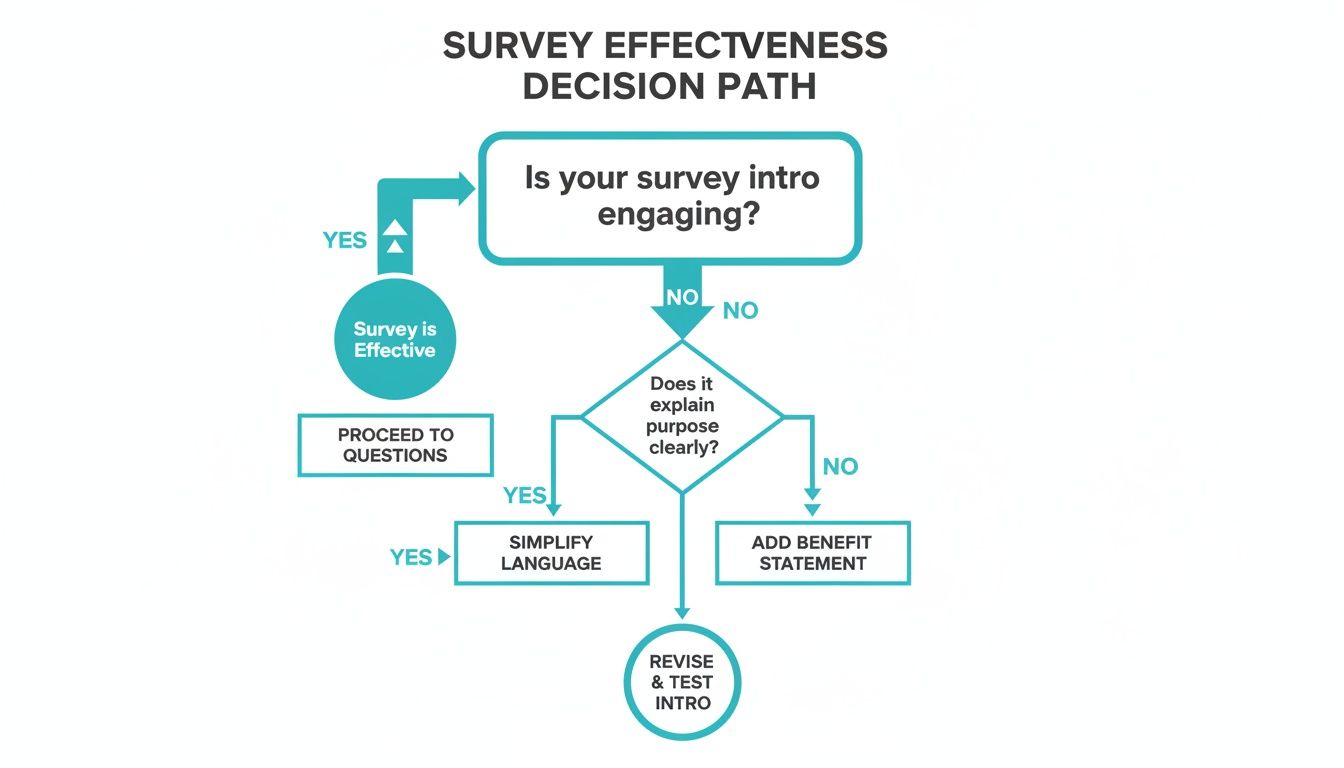
This decision tree nails the simple question at the heart of your intro's success. The takeaway here is that if your intro isn't working, it’s not a dead end—it's just a sign to go back and tweak the core elements we've already covered to get people engaged.
Customer Satisfaction (CSAT) Survey
This one is all about speed. You want to catch customers right after they’ve interacted with your product or support team. The intro needs to be immediate, short, and laser-focused on that single experience.
Example: "Hi [Customer Name], thanks for reaching out to our support team today. Could you spare 60 seconds to tell us how we did? Your feedback is a huge help in training our team and making our service better for everyone. Your answers are completely confidential."
Conversational Tip: If you're using a chatbot for the survey, you can make it feel much more natural. Just pop up with a simple, "How did we do today?" It's a low-pressure question that encourages an instant, honest gut reaction.
Net Promoter Score (NPS) Survey
Brevity is the soul of a good NPS survey. Your introduction has to be lightning-fast, especially on a phone, so you don't add any friction before they get to that classic "How likely are you to recommend..." question.
Example: "Quick question! On a scale of 0-10, how likely are you to recommend [Our Company] to a friend or colleague? It’s just one question that helps us see the big picture of how we’re doing."
Conversational Tip: In a chat flow, you can often skip the formal intro altogether. A friendly "Hey there!" followed immediately by the 0-10 scale gets straight to the point and shows you respect their time.
Employee Engagement Survey
Trust is everything with this one. If your team doesn't feel safe being honest, the data is useless. Your introduction's number one job is to build a strong sense of confidentiality.
Example: "Hi team, it’s time for our annual engagement check-in. This survey will take about 10-15 minutes to complete and is 100% anonymous. Your honest, candid feedback is crucial for helping us build a better workplace together. Please know that results will only ever be shared in an aggregated format, with no individual responses identified."
Market Research Survey
When you're doing market research, you're asking people for their time and genuine expertise. The introduction needs to reflect that by making them feel like the expert in the room whose opinion you genuinely value.
Example: "We're looking for industry experts like you to help us shape a new product we’re developing. This survey will take about 7 minutes. As a small thank you for your valuable insights, you’ll be entered into a drawing for a $100 gift card."
In a world full of different perspectives, getting accurate data is a real challenge. For instance, a recent Gallup International survey on global outlook for 2026 showed a huge divide in optimism between different regions. To capture that kind of complex sentiment, you need a smart approach, and Formbot’s AI can build conversational surveys that intelligently gather those nuanced details.
Post-Event Feedback Survey
Timing is critical here. You have to send this out while the event is still fresh in everyone's mind. The intro should be upbeat and refer to the event by name to jog their memory.
Example: "Thanks for joining us at [Event Name]! We hope you had a great time. We’d love to hear what you thought—please take 3-4 minutes to share your feedback so we can make next year’s event even better. We really appreciate your input!"
Looking for more ideas? You can check out our other survey form examples that dive into even more specific situations.
Common Mistakes That Kill Survey Response Rates

Knowing what to do is only half the battle. You also have to know what not to do. It’s painfully easy to create a survey introduction that sends people running for the 'close tab' button before they even see the first question.
Most of these missteps happen when we get tunnel vision. We focus so much on the data we want to collect that we completely forget about the person on the other side of the screen. The result? An intro that feels like a demand, not a conversation.
The Dreaded Wall of Text
This is the biggest response-killer, hands down. Imagine clicking a survey link and being hit with a massive, dense block of text. It's an instant turn-off. It looks like a huge time commitment, even if it says it's short.
Before: "Welcome to our quarterly customer feedback initiative. In an effort to continually improve our service offerings and product features for valued partners like yourself, we have prepared a brief questionnaire. Your participation is instrumental in helping us ascertain key performance indicators and strategic alignment for the upcoming fiscal year. Please be advised that all submissions are subject to our privacy policy."
After: "Got a minute? We'd love your feedback on your recent experience. Your answers will help us make things better for you. It'll take about 2 minutes, and your responses are completely confidential."
The second version is a breath of fresh air. It's direct, scannable, and respects the reader's time. This is where chat-based tools like Formbot shine, naturally breaking down information into small, digestible chunks.
Vague Purpose and Unclear Goals
People are much more likely to help you if they understand why you're asking. A generic intro that doesn't state its purpose clearly feels random and unimportant. Phrases like "to improve our services" are okay, but they don't really grab anyone.
You have to connect their feedback to a real, tangible outcome. A small tweak in wording makes a world of difference:
- Vague: "We want your opinion on our website."
- Specific: "Help us decide which new feature to build next. Your vote in this 3-minute survey will directly influence our 2026 product roadmap."
The specific version makes the user feel like a collaborator. Suddenly, their opinion has power, which is a huge motivator.
An effective introduction doesn't just ask for time; it demonstrates value. When you show people their opinions will lead to real change, they become invested in the outcome and are more likely to provide thoughtful, complete answers.
Overpromising on Time
This is a cardinal sin of survey writing. Never, ever lie about how long your survey will take.
If you promise a "quick 1-minute survey" and it ends up taking five, you've broken their trust. Not only will they abandon the survey, but they probably won't click on your next one, either. It’s always better to be honest and even slightly overestimate the time commitment.
At the end of the day, a great introduction comes down to empathy. Ditch the corporate jargon, respect people's time, be crystal clear about your intentions, and you'll see your response rates climb.
How to Test and Optimize Your Introduction
Think you’ve nailed your survey introduction? Don't just set it and forget it. The best intros I've ever seen weren't written—they were refined. This is where you stop guessing what works and start letting your audience's behavior guide your decisions.
Launching a survey without a plan to test it is like leaving money on the table. Your goal should be to create a simple feedback loop: test a variation, measure what happens, and make small tweaks that add up to big gains in engagement.
Setting Up Your A/B Tests
Your secret weapon here is A/B testing. It's a straightforward concept: show one version of your intro to one random group of people and a second version to another. Then, you see which one gets more people to actually start the survey. It’s amazing how tiny changes can lead to surprisingly big lifts in response rates.
Here are a few A/B test ideas I've seen work wonders:
- Brevity vs. Detail: Is your audience all business, or do they need a little warming up? Test a short, punchy intro against one that gives more context on why you're asking and what you'll do with the data.
- Tone of Voice: Try a formal, professional tone against something more friendly and casual. You might be surprised to find that a conversational "Hey, got a minute?" outpulls a buttoned-up corporate ask.
- Framing the Incentive: If you're offering a reward, how you phrase it matters. Test "Complete this survey for a 20% discount" against a more benefit-driven "Share your feedback and get 20% off your next order." One feels transactional, the other feels like a thank-you.
The golden rule of A/B testing is to isolate your variables. Change only one thing at a time—the headline, the call-to-action, the time estimate. If you change two things, you’ll never know which one was responsible for the change in performance.
Analyzing the Right Metrics
Don't just look at the final completion rate. That number doesn't tell you the whole story. To really understand if your introduction is doing its job, you have to look at the behavior happening on that very first screen. This is where you can pinpoint exactly what’s turning people away.
Get laser-focused on these metrics:
- Initial Drop-Off Rate: This is your big one. What percentage of people land on your survey and leave without answering a single question? A high number here is a massive red flag that your intro isn't compelling enough to get them over the first hurdle.
- Time to First Answer: How long are people lingering on the introduction before clicking "Start"? A long pause could mean they're confused, hesitant, or just plain uninspired by what they read.
- Completion Rate by Segment: Slice your data. Do new customers react differently to your intro than loyal, returning ones? This insight is gold for personalizing future surveys.
This kind of granular analysis is especially important when you're dealing with complex or shifting opinions. For instance, the Ipsos Predictions Survey 2026 found that while 71% of global citizens are optimistic about 2026, that optimism varies dramatically by region.
Uncovering those nuances is tough with standard, rigid forms. It's why tools like Formbot are so effective; its conversational AI helps create chat-style surveys that can adapt to the user in a way static forms just can't.
Common Questions We Hear About Survey Intros
Even after you've nailed down the basics, a few specific questions always pop up when it's time to actually write that intro. Let's tackle some of the most common ones I get asked, with practical answers to help you fine-tune your approach.
What’s the Perfect Length for a Survey Introduction?
There’s no single magic number, but I’ve found the sweet spot is usually 3-4 short sentences—somewhere in the ballpark of 50-70 words. You're aiming to give just enough context (what it's for, how long it'll take, and a quick privacy note) without putting up a wall of text that scares people away.
Always think mobile-first. If the whole intro doesn't fit comfortably on a phone screen without scrolling, it's too long. Sure, a really complex B2B survey might need a little more runway, but clarity and brevity should always win. A conversational tool can make this a non-issue by feeding the intro one piece at a time, like a text message.
Do I Really Need to Offer an Incentive?
Incentives can be a great way to boost response rates, but they’re not a silver bullet. Sometimes, they even attract the wrong crowd—people who just want the prize and will speed through the questions without much thought.
For internal feedback from your team, the real incentive is the promise of making their workplace better. For your loyal customers, it's about having a voice in the products they love. I generally save the gift cards and discount codes for longer market research surveys or when trying to engage a totally cold audience.
If you do offer one, don't be shy about it. Mention it right at the top of your introduction; it’s a powerful hook to get that first click.
A well-placed incentive can be powerful, but an introduction that highlights the impact of the user's feedback often performs just as well, especially with an engaged audience. It taps into a person's desire to contribute and be heard.
How Is a Conversational Intro Different from a Normal One?
The difference is huge, actually. A traditional intro is just a static block of text. It’s a hurdle the user has to read and process before they can even start answering. Think of it as a one-way announcement.
A conversational introduction, on the other hand, is alive. It's interactive. It might kick off with a friendly "Hey there!" and then reveal the details bit by bit, just like a real chat. For instance, it could say, "I have a few questions about your recent purchase," wait for a click, and then add, "It should only take about 2 minutes."
This back-and-forth feels less like a formal exam and more like a guided conversation. That small shift makes a massive difference in completion rates, especially on mobile, where chat interfaces are already second nature.
Ready to move beyond static forms and see what a conversational approach can do for your response rates? With Formbot, you can describe your needs in plain English and let AI generate a friendly, engaging survey in seconds. Start building for free at tryformbot.com.